
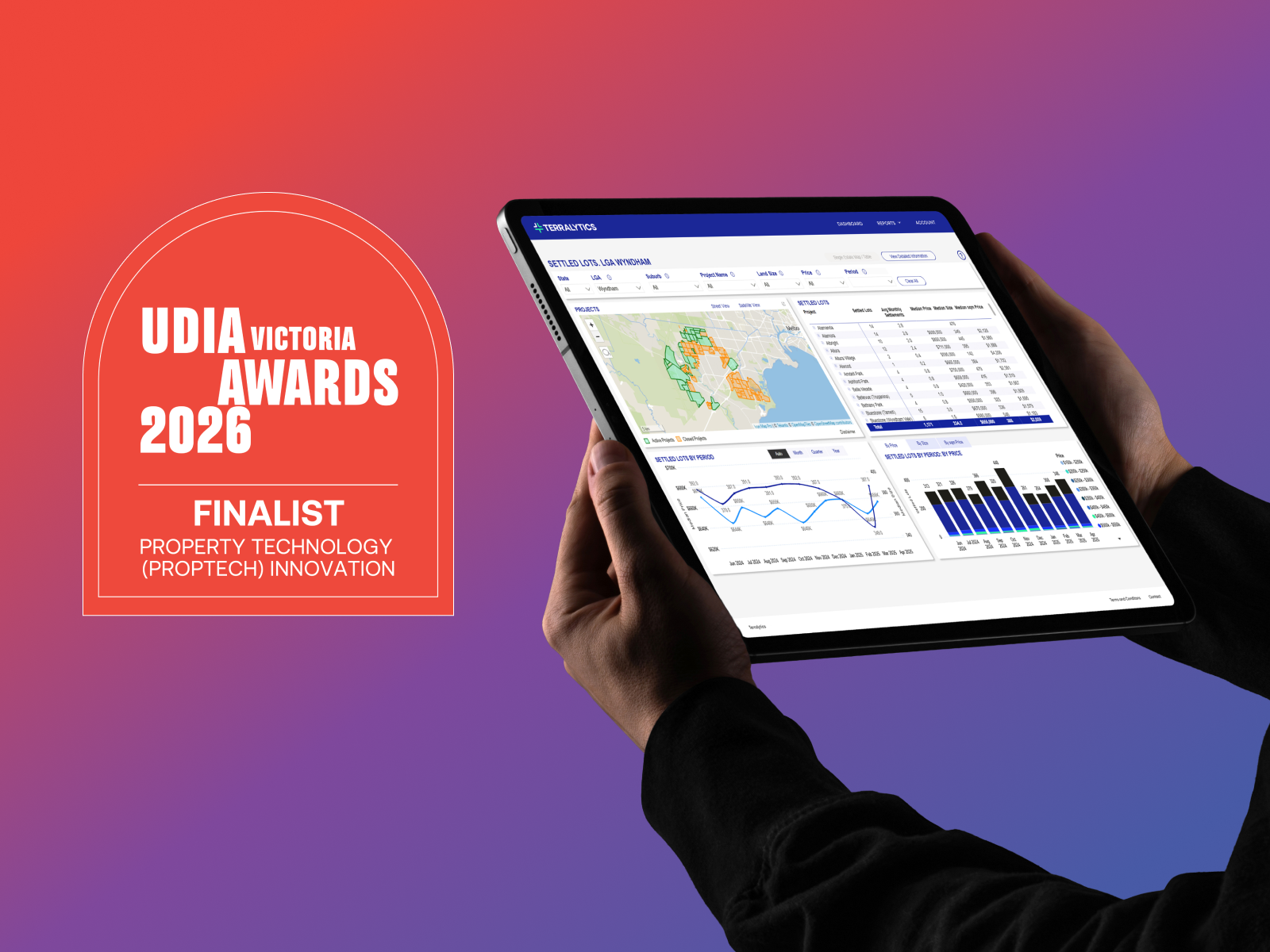
Terralytics has been named a finalist in the Property Technology (Proptech) Innovation Award at the UDIA Victoria Awards 2026. The category recognises technology that is changing how developments in Victoria are planned, designed, built, marketed and experienced. Winners will be announced at the UDIA Victoria Awards Lunch at Crown Palladium, Melbourne, on Friday 27 November 2026.
The UDIA Victoria Awards have recognised excellence in urban development since 1995. Judges assess entries through written submissions, interviews and site visits, so being named a finalist reflects real scrutiny from the industry.
Bringing clarity to Victoria’s land market
Terralytics was built to solve a long-standing problem. Land market intelligence in Victoria has traditionally been pieced together from fragmented sources and quarterly reports that are often out of date by the time they inform a decision.
Terralytics brings 10 years of mapped land data into one platform. Across the main growth areas of Victoria and Queensland, it currently covers more than 900,000 lots, 3,900 active and completed projects and 45 LGAs. Those numbers will grow as coverage expands to New South Wales, the ACT and South Australia between Q4 2026 and Q1 2027, followed by Western Australia in Q2 2027. In Victoria, users can track lot supply, sales, pricing and settlement activity at every scale, from the growth corridor down to the individual lot.
Coverage spans masterplanned and community estates as well as smaller subdivisions across the state’s growth areas.
The platform is used across the property industry, from land developers and builders to valuers, lenders, government and planning bodies and consultants, along with a growing range of other organisations that rely on land market data. It gives them a current view of the residential land market, so they can assess supply, pricing and absorption as it happens, rather than waiting 6 to 18 months for lots to settle and sales to appear in state Valuer-General records.
Built with the industry
Much of the platform has been shaped by the people who use it. Recent releases include a consolidated view of on-market and off-market sales in the corridor-level dashboard and the new Upcoming Stock tab.
Partnerships have also broadened the platform’s reach. Terralytics works with the National Growth Areas Alliance (NGAA) to support better planning across Australia’s growth areas. It also partners with OpenLot, bringing OpenLot’s buyer demand data into the Terralytics Research Library. Terralytics also powers the land price and lot size trends published by OpenLot, which appear on every suburb and LGA page on OpenLot’s website and in the reports OpenLot generates, putting the same data in front of home buyers.
“Being named a finalist means a great deal to the whole team. We started Terralytics because the industry was making major land decisions on information that was fragmented and out of date. This recognition reflects the trust our clients and partners have placed in us, and how much of the platform they’ve helped shape,” said Peter Grant, Managing Director of Terralytics.
The shortlisting caps a strong first full year of sales for Terralytics. It follows the company’s win in the Sales & Marketing Start-Up category at the 2026 Proptech Awards and its selection as a Best New PropTech finalist at The Urban Developer Awards 2026. It also comes after the team delivered the keynote at the UDIA Victoria Conference in June.
Congratulations to our fellow finalists in the Proptech Innovation category, and to everyone recognised across the UDIA Victoria Awards 2026. We look forward to celebrating with the industry on 27 November.
About Terralytics
Terralytics is a Melbourne-based provider of land market intelligence in Victoria and Queensland, giving the property industry lot-level visibility of supply, sales, pricing and settlement activity. Since launching commercially in 2025, it has grown to cover more than 900,000 lots in 45 LGAs, including masterplanned and community estates in key growth corridors. Coverage expands to New South Wales, the ACT and South Australia between Q4 2026 and Q1 2027, and to Western Australia in Q2 2027.