
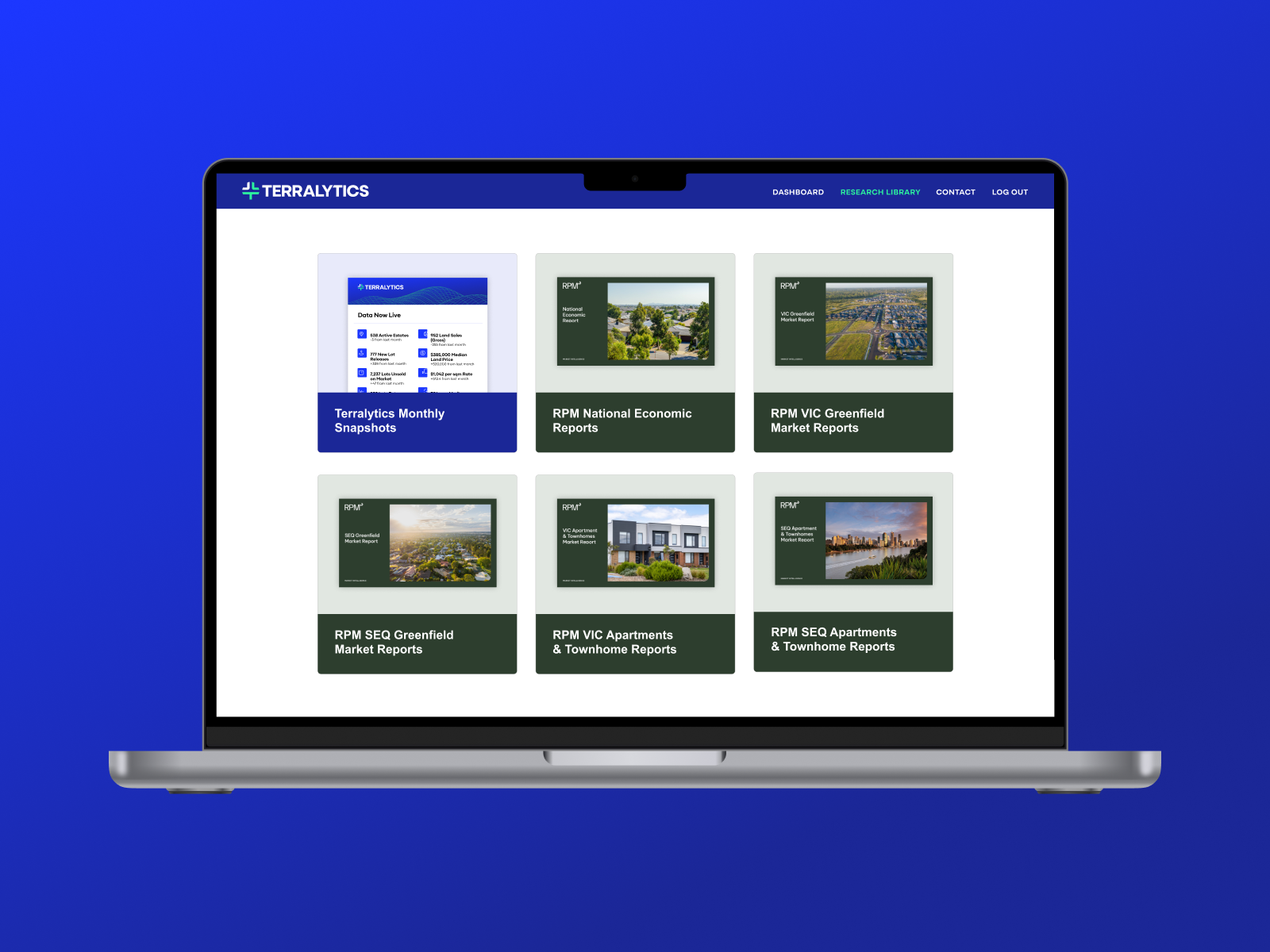
All your market reports and property data in one place
Terralytics has launched the Research Library, bringing together market reports, research and property data in one central location.
The Research Library provides access to comprehensive greenfield market reports Australia professionals rely on, covering greenfield, town home and apartment markets.
Developed to make market research faster and easier to access, the Research Library provides users with a single place to explore reports and datasets covering different markets, time periods and property types.
With market data spread across different reports, time periods and property types, finding the right information can often mean searching through multiple sources. As a single research platform, the Research Library brings this information together in one streamlined location, giving users a simpler way to explore the data they need.
Report Summary
Terralytics Monthly Snapshots
Each month, Terralytics publishes a state-level snapshot covering the key indicators of the residential land market – active estates, new lot releases, gross land sales, lots unsold on market, lots returning to market, median land price, $/sqm rate and median land size. Every metric is shown alongside its change from the previous month, giving a quick read on which way each market is moving. Snapshots are released for each state as new data comes in, providing a consistent monthly checkpoint on market activity without needing to pull the numbers together manually.
RPM National Economic Reports
This report provides a comprehensive assessment of Australia’s economic and property market conditions at a national level, using a structured set of leading indicators that collectively capture trends in growth, inflation, household behaviour, labour market performance, credit conditions and residential supply.
RPM VIC Greenfield Market Reports
These reports bring together the latest economic, building and property market data to provide an overview of market conditions, development activity and trends across key growth corridors and regional markets.
RPM SEQ Greenfield Market Reports
This report breaks down the latest economic and building data shaping South East Queensland’s land market. It covers population and housing demand trends, property market pricing and borrowing power, a full snapshot of the vacant land market (lot costs, sizes, and sales by region), development site activity, and an outlook for what’s ahead – giving a clear, data-backed view of where the SEQ property and land market currently stands.
RPM VIC Apartments & Townhome Reports
This report present the latest economic and building data shaping Victoria’s apartment and townhouse market. It covers market fundamentals including apartment financing and population growth, buyer activity across Victorian home purchasers and the Melbourne unit market, dwelling supply and building approvals, construction costs and outlook, and a broader economic outlook — offering a comprehensive, data-driven view of where Victoria’s medium-to-high density housing market currently stands.
RPM SEQ Apartments Reports
These report present the latest economic and building data shaping South East Queensland’s apartment market. It covers demand and supply dynamics including investor and owner-occupier loans, approvals, commencements, and construction pipeline value, unit pricing and rentals including value relativity between houses and units, internal square metre rates, development site activity, and an outlook for what’s ahead – offering a comprehensive, data-driven view of where SEQ’s apartment market currently stands.
RPM VIC Resales Feature
This report examines the shifting dynamics between Melbourne’s resale and retail land markets, where resale stock is becoming more expensive while retail stock falls in price. It breaks down corridor-level movements across Melbourne, comparing lot sizes, pricing trends, and market backlog between the South East and Western corridors, alongside the impact of rising interest rates, tax changes, and build costs on buyer capacity and developer strategy – offering insight into where Victoria’s secondary land market is heading and what could drive future demand.